Chemical, pharmaceutical and food plants ask two things of a vacuum pump: keep the process stream clean, and survive whatever the process sends through it. Chemical lines pull aggressive solvent vapors, pharmaceutical batches need clean and recoverable gas, and food processing sends water vapor and fine particles downstream. A dry screw vacuum pump meets both demands with an oil-free gas path. This guide covers the selection factors, the industry builds, and where liquid ring or Roots staging fits better.
Why Dry Screw Fits Chemical, Pharmaceutical and Food Duties
A dry screw vacuum pump moves gas with two parallel screw rotors turning inside the pump body. The rotors never touch each other or the casing: precise clearances do the sealing, and timing gears keep the rotors in step, so no oil or sealing water enters the pumping chamber. Three results matter to process plants:
- Clean process stream — the gas path contains no oil, so discharged gas stays oil-free and solvents can be recovered at the exhaust
- No working fluid to treat — condensable and mildly corrosive vapors pass through without mixing into seal water or oil that would later need treatment and disposal
- Batch-to-batch consistency — with no fluid loop to contaminate, the pump runs the next batch under the same conditions as the first
The LGBJ series adds two design details. A multi-lead screw works like several pump stages in series inside one body, and gas travels directly from suction to exhaust with no channels between stages. That direct path lowers the risk of clogging and simplifies cleaning when the stream carries condensable gases, dust or particles.
The Selection Factors That Actually Matter
Six factors decide how a screw pump performs on a specific duty:
- Operating pressure — size against the pump curve at the actual process pressure; most duties run well above the pump’s ultimate pressure
- Pumping speed and pump-down time — the volume to evacuate and the time allowed set the displacement, plus a margin for vapor load
- Gas composition — condensable fraction, corrosive species, dust loading and any explosion-group classification decide materials, coatings and motor build
- Temperature control — pump temperature governs condensation and polymerization inside the chamber, so the cooling scheme matters as much as screw geometry
- Utilities and installation — dry pumps still need cooling water, purge gas, silencing and a foundation plan
- Service intervals — bearings, seals and clearances set the maintenance cycle, and the interval under your own duty conditions is the figure to plan with
Matching the Pump to Your Industry
The same dry screw platform is configured differently for each industry:
- Chemical processing — corrosion-resistant chamber coatings, seal purge gas and, where the gas classification requires it, explosion-proof motor arrangements; solvent recovery at the exhaust often carries the economic case
- Pharmaceutical production — cleanable surfaces, drain points and seal designs suited to cleaning regimes, plus documentation for a validated process
- Food processing — water vapor, sugars and fine particles call for temperature control that keeps deposits off the rotors, and generous margins on pump-down time
The LGBJ series covers these duties in six sizes. All models run on cooling water at 20°C ±5°C with a purge gas supply, and the two largest reach 0.05 mbar:
| Model | Pumping speed (L/s) | Ultimate pressure (mbar) | Motor power (kW) | Cooling water (L/h) | Purge gas (m³/h) | Weight (kg) |
|---|---|---|---|---|---|---|
| LGBJ-30 | 30 | 0.3 | 4 | 120 | 18 | 260 |
| LGBJ-70 | 70 | 0.3 | 7.5 | 210 | 25 | 370 |
| LGBJ-110 | 110 | 0.3 | 11 | 240 | 28 | 400 |
| LGBJ-150 | 150 | 0.3 | 11–15 | 480 | 30 | 580 |
| LGBJ-220 | 220 | 0.05 | 18.5–22 | 600 | 48 | 680 |
| LGBJ-300 | 300 | 0.05 | 22–30 | 720 | 48 | 720 |
Pump shaft speed is about 2,900 rpm across the range, and rated noise is 82–85 dBA.

Dry Screw vs Liquid Ring — a Quick Decision Table
Liquid ring pumps remain the main alternative for wet, rough duties. The wet versus dry comparison explains both families in detail; the table gives a quick orientation for process work:
| Decision input | Points to dry screw | Points to liquid ring |
|---|---|---|
| Process contamination | Zero tolerance for product contact; solvent recovery required | Contamination tolerable or fluid-compatible |
| Vapor handling | Condensable, valuable or toxic vapors to recover | Large water vapor loads with low-cost disposal |
| Utility demand | No working-fluid loop; power, cooling and purge gas only | Water supply and treatment available at low cost |
| Depth requirement | Deep vacuum with a clean gas path | Moderate vacuum, slugs and particles expected |
| Lifecycle view | Higher entry price, lower fluid and disposal cost | Lower entry price, ongoing fluid management |
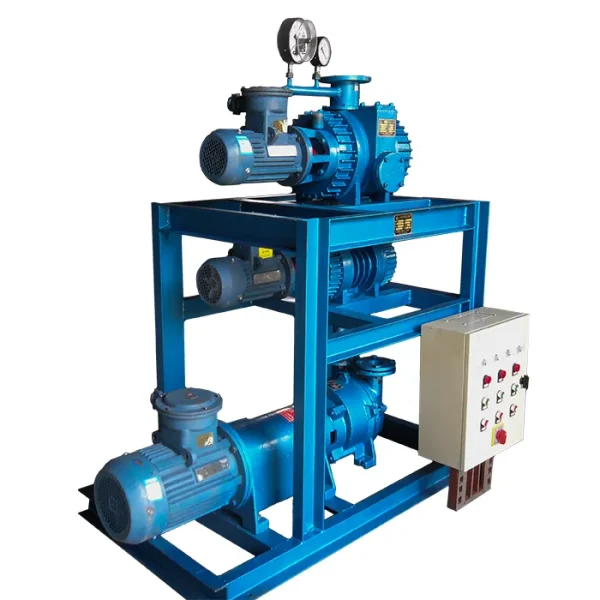
Many plants run both: dry screw pumps on clean, deep-vacuum stages and liquid ring pumps on wet roughing work. When a process needs lower pressure than one screw stage reaches, a Roots booster on a dry screw backing pump extends the range and keeps the gas path oil-free. The JZJLG roots screw vacuum pump unit pairs a ZJ series Roots pump with an LG series screw forepump. Its Roots chamber is nickel-plated and the screw pump carries a nickel-plated or PTFE coating for water vapor, solvent gases and corrosive substances, with unit configurations built on Roots stages from ZJ-70 to ZJ-2500 for low-pressure duties and solvent recovery.
Common Sizing Mistakes
Four sizing mistakes recur in process vacuum projects:
- Specifying “full vacuum” — most processes need a defined operating pressure; specifying that point avoids paying for depth the process never uses
- Sizing for the peak — a pump matched to an occasional peak runs inefficiently at normal duty; staging or a buffer vessel handles the peak more economically
- Underestimating the condensable fraction — vapor load changes pump-down time and internal temperatures significantly
- Leaving out the exhaust side — recovery, scrubbing and silencing belong in the same selection as the pump
FAQ
How Does a Screw Vacuum Pump Work?
Two parallel screw rotors turn in opposite directions with a small clearance between them. Gas enters at the suction end, is trapped between the screw flutes and travels axially as the rotors turn, compressed along the way and discharged at the exhaust end. The motor drives one shaft through a coupling and timing gears drive the second, so the rotors stay synchronized without contact and no oil enters the gas path.
What Should Be Specified for an Explosion-Group Duty?
Start from the gas classification: the motor arrangement, surface temperature class and seal purge scheme all follow the ATEX or equivalent group of the process. Sharing the gas analysis with the manufacturer early lets these points shape the pump build from the start.
How Does Maintenance Compare With a Liquid Ring Pump?
A screw pump replaces fluid management with mechanical service. There is no working fluid to test, treat or dispose of, while bearings, seals and clearances need scheduled attention. Clean duties give long, predictable service intervals; in dusty or polymerizing service, temperature control and flushing frequency set the interval.
Can One Screw Pump Serve Several Vessels?
Yes, and it is often the economical design. One dry screw set can switch between vessels through valves or serve a shared header when it is sized for the worst gas mixture and the highest vapor load it will see. A stage added later with a different solvent class needs its own selection review.
A dry screw pump is sized best from the duty sheet: gases, pressures, temperatures and cycle. Share your process conditions with the Bojie team, or compare the screw vacuum pump range and the Roots vacuum pumps, and the selection comes back as a specification matched to real pump curves.