You can understand the liquid ring vacuum pump working principle by observing how an impeller spins inside a chamber filled with liquid. The impeller is positioned off-center, so as it rotates, the liquid is pushed outward, forming a ring due to centrifugal force. This liquid ring creates sealed spaces that expand and contract, drawing in gas and compressing it. The liquid acts as a seal and also helps keep the pump cool.
Unlike rotary vane or dry vacuum pumps, a liquid ring vacuum pump does not require oil for sealing or cooling. Since there are no metal parts rubbing against each other inside, the pump operates quietly and has a long service life.
The liquid ring vacuum pump working principle relies on using liquid to transfer energy and compress gas with minimal heat generation. You can use water or other liquids as the sealing medium, making this pump suitable for a wide range of applications.
Liquid ring vacuum pump working principle

How does a liquid ring pump work
You can learn how the liquid ring vacuum pump working principle works by seeing how it moves gas step by step. The pump uses the positive displacement principle. This means it traps a set amount of gas and moves it from where it comes in to where it goes out. The way it works depends on the impeller, the seal liquid, and the special shape of the pump.
Here is how a liquid ring pump works, step by step:
- The impeller turns inside a round case. A motor makes it spin.
- The spinning pushes the seal liquid out to the wall. This makes a smooth ring inside the case.
- The liquid ring forms small, closed spaces between the impeller blades and the case.
- Gas comes in through the suction port. It fills the empty spaces in these chambers.
- As the impeller keeps turning, the chambers get smaller. The liquid ring holds its shape and squeezes the gas.
- The squeezed gas moves toward the discharge port. The impeller and liquid ring push it along.
- The pump pushes the compressed gas out through the discharge port.
Tip: The seal liquid makes a tight seal so gas cannot leak. It also takes in heat and keeps the pump cool while it works.
The liquid ring vacuum pump working principle helps make a steady vacuum. There are no sudden changes in pressure. The pump can move gases that have solids or water in them. This makes it good for many jobs.
Impeller and liquid ring formation
The impeller is the most important part of the liquid ring vacuum pump. It sits off to one side inside the pump case. This special spot is important because it makes chambers of different sizes as the impeller spins.
- The impeller has blades on a center hub. When it spins, the seal liquid is pushed out to the wall. This makes a liquid ring against the case.
- Because the impeller is off-center, some blades go deeper into the liquid ring than others. This makes closed spaces, called “cells,” between the blades and the liquid ring.
- As the impeller turns, the size of these cells changes. On one side, the cells get bigger and pull in gas. This makes a vacuum. On the other side, the cells get smaller and squeeze the gas before it leaves through the outlet.
The liquid ring acts like a moving piston. It blocks the gas, stops leaks, and helps squeeze the gas as the chamber size changes. The seal liquid must stay at the right level and temperature. This keeps the vacuum strong and the pump working well.
| Step/Component | Description |
|---|---|
| Seal Liquid Formation | The spinning impeller makes a liquid ring. This creates small spaces for gas. |
| Eccentric Rotor Axis | The off-center impeller makes chambers fill and empty as it spins. |
| Gas Flow Paths | Gas comes in through the vacuum inlet and goes out the discharge port. |
| Heat Dissipation | The seal liquid takes in heat from squeezing the gas and some is pushed out. |
| Seal Fluid Replenishment | New seal liquid replaces what is lost to keep the seal and pump working right. |
You can see the liquid ring vacuum pump working principle needs the impeller to move just right, the seal liquid, and the pump’s shape. This design helps you get a steady vacuum and makes the pump work well in many places.
Types and design
Single-stage vs two-stage
When you choose a vacuum pump, you often decide between a single-stage and a two stage liquid ring vacuum pump. Each type works differently and fits different jobs.
- A single-stage pump compresses the gas only once. You get a simple design and easy maintenance. This pump works well for low to moderate vacuum needs, such as packaging or water treatment. It usually reaches vacuum levels around 33 mbar (abs).
- A two stage liquid ring vacuum pump compresses the gas twice. This design lets you reach much deeper vacuum levels, sometimes as low as 2 mbar (abs). You use this pump for demanding jobs like chemical processing or semiconductor manufacturing.
- Two stage liquid ring vacuum pumps have special features. These include conical porting, lobe purge, and anti-cavitation technology. These features help the pump last longer and work better in harsh conditions.
- Single-stage pumps cost less and need less maintenance. Two stage liquid ring vacuum pumps cost more and need more care, but they give you higher vacuum and handle larger gas loads.
Tip: If you need a deep vacuum or work with tough gases, you should pick a two stage liquid ring vacuum pump.
Seal liquids
The seal liquid forms the ring that makes the vacuum possible. You can use water, oil, or even special chemicals. Water is the most common choice because it is easy to get and safe for most jobs. Oil can help you reach lower vacuum pressures, but you use it less often.
| Seal Liquid | Advantages | Disadvantages |
|---|---|---|
| Water | Simple, safe, handles dust and wet gases, low wear | Limited vacuum, lower efficiency, needs more water |
| Oil | Reaches lower vacuum, good for special jobs | Less common, can be harder to manage |
The seal liquid touches the gas you pump. You must pick a liquid that matches your process. The vapor pressure of the seal liquid sets the lowest vacuum you can reach. The liquid also cools the pump and helps prevent unwanted chemical reactions.
Fluid systems
You can set up the fluid system in three main ways:
- Once-through system: You use the seal liquid once, then discharge it. This setup is simple and cheap, but it uses more water.
- Partial recirculation: You recycle some of the seal liquid and add fresh liquid as needed. This method saves water and works well for many jobs.
- Total recirculation: You reuse all the seal liquid. This system uses the least water and works best when you need to save resources or handle special gases.
Note: The way you manage the fluid system affects your costs and the environment. Using less water helps you save money and meet environmental rules.
You must keep the right amount of seal liquid in the pump. Too much or too little can hurt performance. The fluid system you choose depends on your vacuum needs, water supply, and local rules.
Applications and performance
Industrial uses
Liquid ring vacuum pumps are used in many industries. They can handle wet, dirty, or harsh gases. You see them in chemical plants, power plants, food factories, and mines.
Here is a table that shows where these pumps are used:
| Industry Sector | Common Applications |
|---|---|
| Chemical | Solvent recovery, vapor compression, distillation, drying, degassing, pneumatic conveying |
| Pharmaceutical | Freeze drying, sterilization, moisture extraction, vacuum condensation |
| Food Processing | Packaging, freeze drying, vacuum cooling, contamination control |
| Wastewater Treatment | Separator vessels, moisture extraction, vapor compression, filter tank backwashing |
| Power Generation | Gas compressors, condenser pressure control, ash handling, vapor recovery |
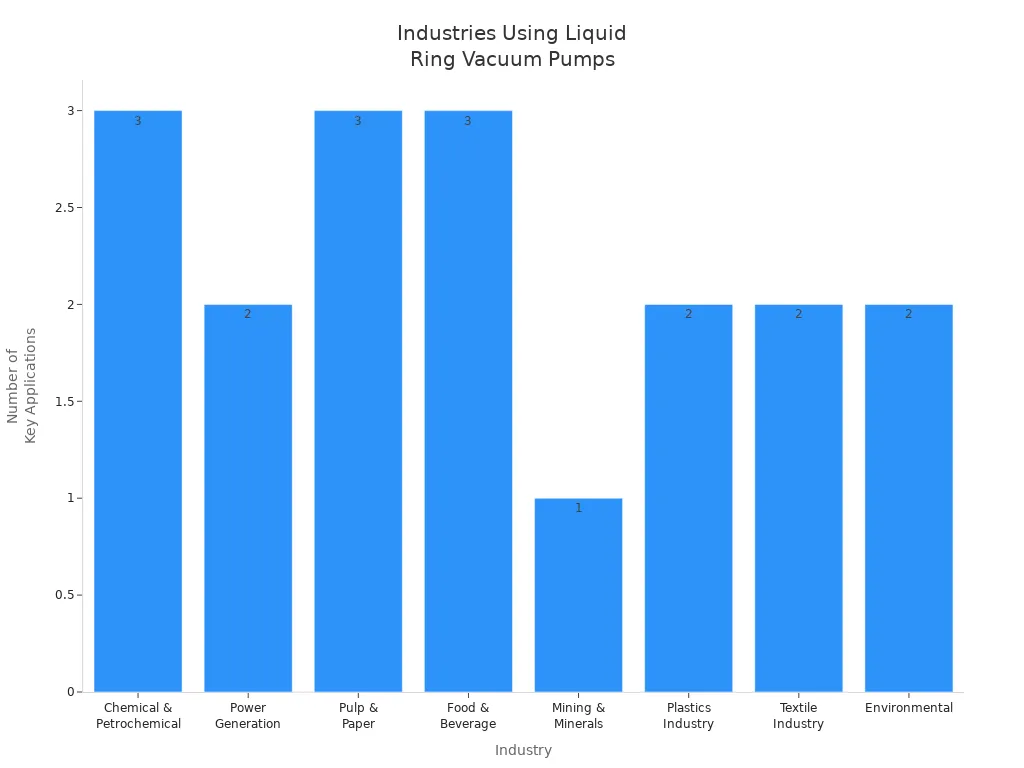
These pumps help recover solvents in chemical jobs. They are used for distillation and vapor recovery too. In medicine, they help with freeze-drying and keeping things clean. Food factories use them for packaging and taking out water. Power plants use them to keep pressure low and move steam.
Many industries need these pumps for important work. The chart below shows how different industries use liquid ring vacuum pumps:
Tip: Pick a liquid ring vacuum pump if you need a strong vacuum in places with wet or dirty air.
Efficiency factors
You want your vacuum pump to work well and last long. Many things can change how well your pump works.
- The shape of the impeller and case affects the vacuum level. A good shape lets liquid move easily and saves energy.
- The temperature of the working liquid is important. If it gets too hot, the vacuum will not be as strong.
- The size and shape of the inlet and pipes matter. They help gas move in and out of the pump.
- The pump parts must resist rust if you use harsh chemicals.
- A good cooling system keeps the liquid at the right temperature. This stops the pump from getting too hot.
- Taking care of the pump is important. You should check the liquid, oil the bearings, and look for leaks or odd sounds.
Here is a list of steps to keep your pump working:
- Check wires and connections for damage.
- Oil the bearings and check if they line up.
- Clean the fans and heat exchangers.
- Test the safety switches and change fuses.
- Measure the vacuum at the inlet and outlet.
- Look for leaks in seals and gaskets.
- Listen for strange sounds or shaking.
- Clean inside parts to remove dirt.
You need clean liquid for the pump to work well. Dirty liquid can break the pump and lower the vacuum. Pumps with recirculation and coolers can handle dirty gases better and need less cleaning.
Most liquid ring vacuum pumps last from 6,000 to 10,000 hours if you take care of them. You should check your pump every 1,000 to 3,000 hours to keep it working well.
Note: If you hear odd noises or see leaks, turn off the pump and check for problems. Regular care stops breakdowns and keeps your vacuum strong.
You can learn how a liquid ring vacuum pump works by looking at these steps: First, the offset rotor spins inside a housing filled with fluid. The spinning makes the liquid move out and form a ring. Gas comes into the middle part of the pump. The pump squeezes the gas to make it smaller. The compressed gas leaves through the outlet.
| Unique Feature | Benefit |
|---|---|
| Simple Structure | It is easy to use and take care of |
| Minimal Internal Friction | There is less wear, so it lasts longer |
| Isothermal Compression | It is safe for gases that can catch fire |
| Versatility | It works with wet, dusty, or harsh gases |
This pump saves energy and does not make much noise. It can do hard jobs and works well in many industries. Liquid ring vacuum pumps are a good pick when you need steady and efficient work.