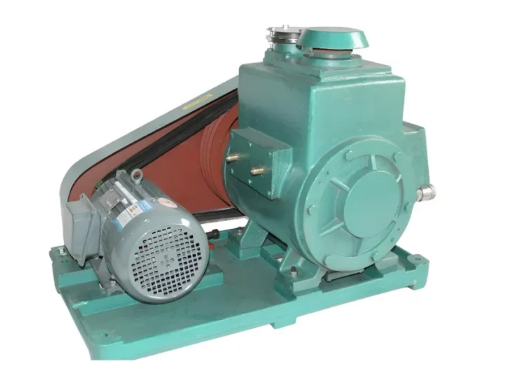
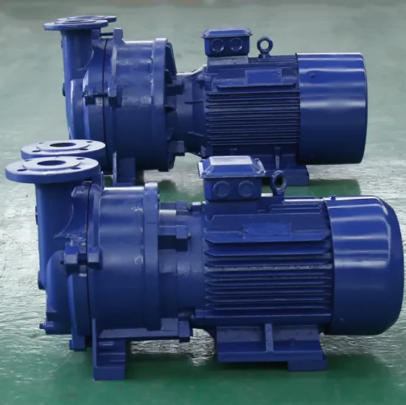
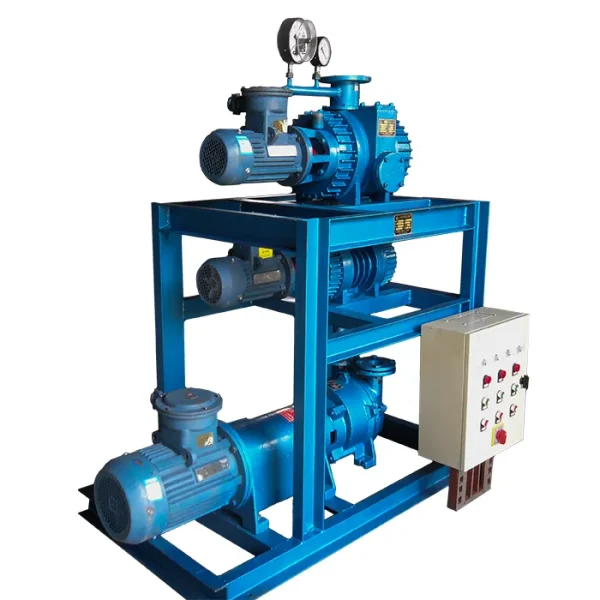
Vacuum technology plays a crucial role across various industries, from petrochemical processing and pharmaceuticals to food packaging and metallurgy. Among the numerous vacuum pump designs, the two stage water ring vacuum pump stands out for its efficiency, reliability, and ability to achieve deeper vacuum levels than its single-stage counterpart. In this article, we will explore the two stage water ring vacuum pump working principle, structural design, application scope, and performance advantages.
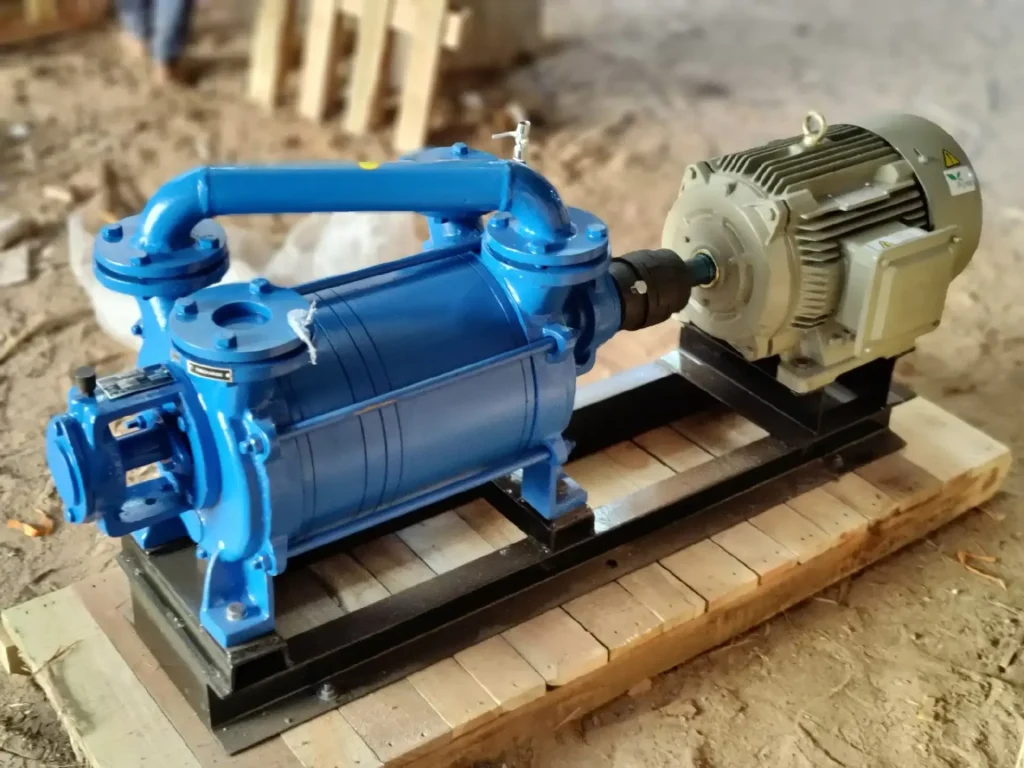
What Is a Two Stage Water Ring Vacuum Pump?
A two stage water ring vacuum pump is a type of rotary positive displacement pump that uses water (or another liquid) as a sealant to create a vacuum. It operates in two successive compression stages to extract gases and vapors from a sealed system. The second stage further compresses the discharge from the first stage, allowing for lower ultimate vacuum pressures and improved volumetric efficiency.
Unlike dry vacuum pumps, the water ring design eliminates internal metal-to-metal contact, reducing wear and increasing durability. This feature makes it especially suitable for demanding industrial processes that require stable operation, tolerance to vapor loads, and corrosion resistance.
Structural Design of a Two Stage Water Ring Vacuum Pump
Before diving into the two stage water ring vacuum pump working principle, let’s first understand its structure. A typical pump consists of:
- Pump Casing – Encloses the rotor and water ring.
- Rotor – An eccentrically mounted impeller that rotates inside the casing.
- Shaft – Connects to a motor that drives the rotor.
- Water Ring – A ring of sealing liquid formed by centrifugal force.
- Inlet and Outlet Ports – Guide gases into and out of the compression chambers.
- Interstage Channel – Connects the discharge of the first stage to the inlet of the second stage.
- Mechanical Seal or Gland Seal – Prevents air leakage along the shaft.
- Separator Tank – Collects the liquid-gas mixture discharged from the pump and recirculates the sealing fluid.
Each stage includes a rotor chamber, inlet port, and outlet port, designed in a way that allows two sequential compression actions to occur.
Two Stage Water Ring Vacuum Pump Working Principle
The two stage water ring vacuum pump working principle is based on the creation of an eccentric liquid ring inside the pump casing, which compresses gas through cyclic volume changes.
Here’s a step-by-step breakdown of the operation:
1. Formation of the Water Ring
When the rotor rotates inside the casing, the centrifugal force pushes the sealing water outward, forming a rotating water ring. Due to the offset between the rotor and the pump casing, the water ring remains concentric to the casing but eccentric to the rotor.
This eccentricity creates a series of variable volume chambers between the impeller blades and the water ring.
2. First Stage Suction and Compression
As the rotor turns, the volume between the blades increases on the suction side. This draws gas into the pump from the system through the inlet port.
As the rotation continues, the trapped gas moves toward the compression side of the first stage, where the volume decreases. This compresses the gas and pushes it through the interstage channel into the second stage.
3. Second Stage Suction and Final Compression
In the second stage, the process is repeated. The partially compressed gas enters a new set of variable chambers where it is again compressed as the volume decreases.
Finally, the fully compressed gas-liquid mixture is discharged through the outlet port to the separator tank. The gas is vented or processed, and the liquid is cooled and returned to the pump.
This two-stage configuration allows the pump to reach much lower vacuum pressures — typically around 33 mbar (25 Torr) or even lower, depending on the operating liquid temperature and system design.

Key Performance Advantages
The two stage water ring vacuum pump working principle offers several technical and operational benefits over single-stage systems:
1. Deeper Ultimate Vacuum
The second compression stage significantly reduces the final pressure. This makes two-stage pumps ideal for applications where deep vacuum levels are required but oil-based pumps are not feasible.
2. Improved Efficiency at Low Pressures
Single-stage pumps often struggle as they approach their lowest vacuum levels, with performance dropping significantly. Two-stage pumps maintain more stable efficiency across a broader range of operating pressures.
3. Stable Operation with Wet or Saturated Gases
Because water ring pumps use a liquid seal, they can handle condensable vapors, wet gases, and even light entrained liquids without damage. This is a major advantage in chemical or pharmaceutical applications.
4. Low Maintenance Requirements
With no metal-to-metal contact and fewer moving parts, water ring pumps have longer lifespans and lower maintenance costs compared to oil-lubricated or dry-running pumps.
5. Corrosion Resistance
By using corrosion-resistant materials (e.g., stainless steel, bronze), two stage water ring pumps can be used in aggressive environments where chemical vapors or acids are present.
Applications of Two Stage Water Ring Vacuum Pumps
Thanks to the working principle of sequential compression and robust construction, two-stage water ring vacuum pumps are widely used in:
- Chemical Processing – Solvent recovery, distillation, drying
- Petrochemical Industry – Vacuum distillation towers, gas recovery
- Pharmaceutical Manufacturing – Vacuum drying, crystallization, filtration
- Power Plants – Condenser evacuation systems, priming pumps
- Food Industry – Vacuum packaging, degassing, evaporation
- Paper and Pulp – Dehydration processes
- Textile Industry – Moisture removal, fiber treatment
Their ability to handle saturated gases, aggressive chemicals, and fluctuating inlet pressures makes them highly adaptable for critical industrial applications.
Factors Affecting Pump Performance
While the two stage water ring vacuum pump working principle is well-suited for many applications, certain factors can impact its real-world performance:
1. Seal Water Temperature
Colder seal water allows deeper vacuum levels. Warmer water raises vapor pressure inside the pump, limiting the ultimate vacuum. This is why seal water cooling systems are commonly used.
2. Seal Water Quality
Poor quality water can cause scaling, corrosion, or bacterial growth inside the pump. Using filtered or treated water helps extend equipment life.
3. Gas Composition
Heavily laden or sticky gases may require pre-filters or scrubbers. Additionally, non-condensable gases may reduce vacuum efficiency.
4. Speed and Motor Power
Pump RPM and motor sizing must be matched to the system’s vacuum requirement and throughput. Too high a speed can cause cavitation, while too low may reduce capacity.
Maintenance and Troubleshooting Tips
To maximize performance and extend the lifespan of a two-stage water ring vacuum pump, follow these best practices:
- Monitor Seal Water Flow and Temperature regularly
- Clean Interstage Channels to prevent clogging
- Inspect Mechanical Seals and Bearings periodically
- Flush the Pump after handling corrosive or sticky substances
- Use Original Replacement Parts for long-term reliability
Regular maintenance not only ensures consistent vacuum performance but also reduces the risk of unexpected downtime.
Conclusion
Understanding thetwo stage water ring vacuum pump working principle is essential for engineers, maintenance technicians, and procurement professionals looking to optimize vacuum operations. Through dual-stage compression, these pumps deliver superior vacuum performance, energy efficiency, and durability across a broad spectrum of industries.
Whether you’re operating in a chemical plant, pharmaceutical facility, or food processing line, selecting the right two-stage water ring pump can drastically improve system reliability and operational output.
By choosing a high-quality, properly sized pump and ensuring regular maintenance, you can leverage all the advantages of this time-tested vacuum technology.